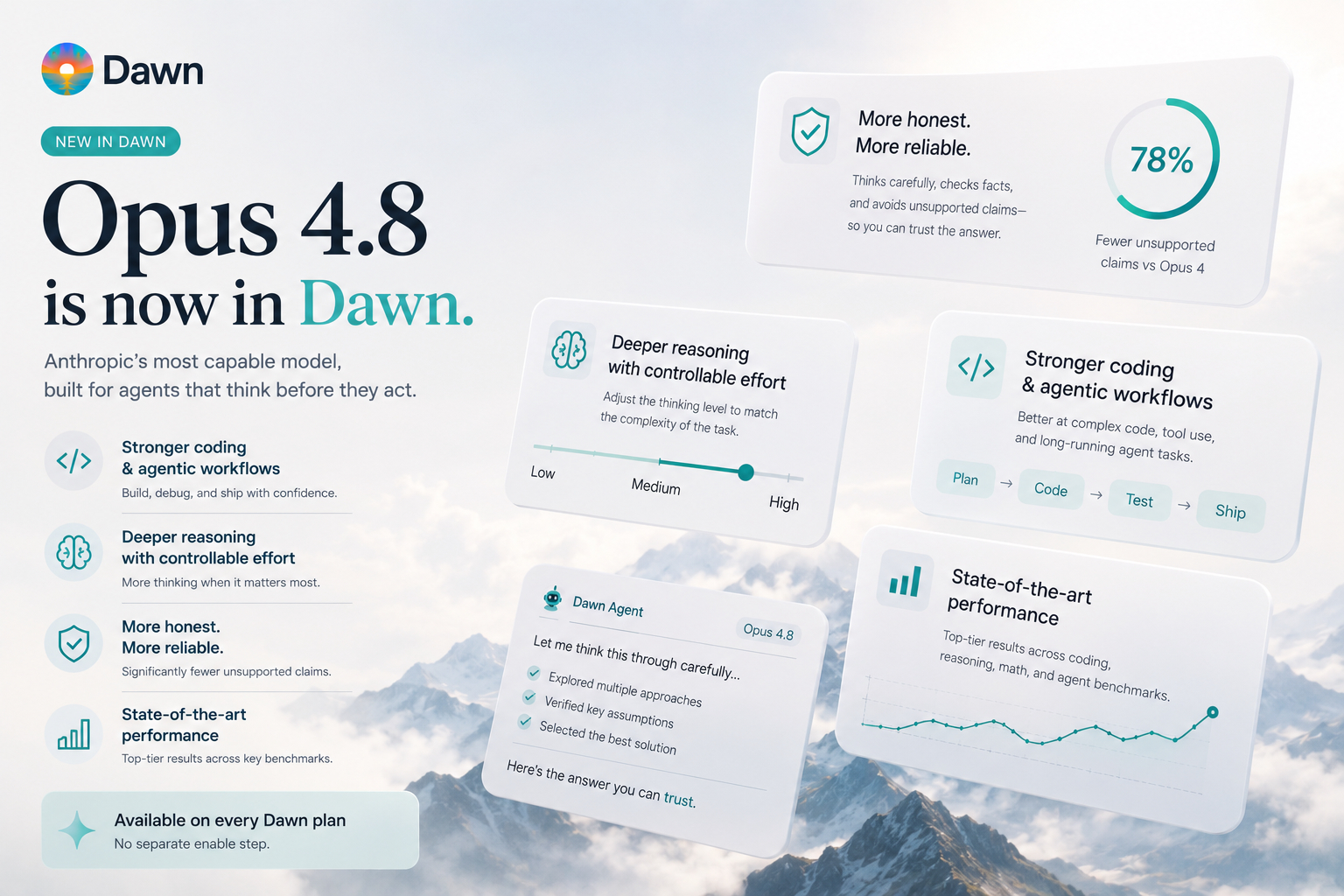
Claude Opus 4.8, Anthropic’s most capable generally available model, is now in the Dawn model catalogue. It is selectable for any Dawn agent from launch day, with no separate rollout step and no migration required.
The new entry appears in the Anthropic section of the model picker alongside Opus 4.7 and the rest of the Claude lineup. Open the agent you want to upgrade, change the model, save, and the next message that agent answers uses Opus 4.8.
What’s New In 4.8
Claude Opus 4.8 builds on Opus 4.7. Anthropic’s release notes call out improvements in three places that matter most for the way Dawn agents actually work:
- Long-horizon agentic coding. Better long-context handling, fewer compactions on long traces, and better recovery when compaction does happen. Dawn agents that run for many turns over a connected source see this most.
- Reasoning effort calibration. The effort parameter now behaves more reliably at each level across a wider range of domains.
- Tool triggering. Fewer cases of the model skipping a tool call that the task genuinely required. Worth flagging on its own, since this was a real friction point on Opus 4.7 for some agentic flows.
The release also brings API-level changes that affect how the rest of the platform behaves around the model.
Mid-conversation system messages let an application append updated instructions later in a long-running conversation without restating the full system prompt, which preserves prompt-cache hits on the earlier turns and reduces input cost on agentic loops.
Adaptive thinking is now the only supported thinking mode. The model decides per turn whether to reason before answering, so obvious turns respond directly and the complex ones get the reasoning they actually need without wasting tokens on the easy ones. Effort defaults to high on Opus 4.8 across every surface, so agents do not need to set this explicitly to get the new default behaviour.
The minimum cacheable prompt length drops to 1,024 tokens, down from a higher minimum on Opus 4.7. Short system prompts that were not cacheable before can now create cache entries with no code changes.
Context Window and Output
Opus 4.8 supports a 1M token input context window by default on the Anthropic API, with 128K max output tokens. That is the same context envelope as Opus 4.7, but with the long-context improvements above, so Dawn agents that genuinely use the full context window benefit most from the upgrade.
Selecting It For An Agent
Opus 4.8 appears in the Anthropic section of the model catalogue alongside Opus 4.7. Open the agent you want to upgrade, change the model, save. The agent’s system prompt, skills, memory pages, and connected sources all carry over unchanged.
Workspaces using bring-your-own-key for Anthropic can point Dawn at their workspace Anthropic key for the same routing. Workspaces using Dawn-managed credentials see the new entry appear automatically.
As with the GPT-5.5 release, the choice of model is per-agent. A workspace can keep its high-volume conversational agents on a faster model and move just the planning or review agents that benefit most from Opus 4.8.
Where Opus 4.8 Earns Its Keep
The model is a fit for the same kind of work Opus 4.7 was already aimed at, with the improvements above making it noticeably better at the long-horizon parts of that work. Long agentic runs across multiple tool calls. Multi-step explore runs that need to hold context across many turns. Code review and architectural decisions where the agent has to weigh several constraints at once.
The tool-triggering improvement is worth calling out separately. If you had an Opus 4.7 agent that occasionally skipped a tool call that should have run, Opus 4.8 makes that noticeably less common without you having to add explicit “remember to call this tool” instructions to the system prompt.
For high-volume short-form work, the catalogue still offers cheaper and faster models that handle those requests just as well. Opus 4.8 is best pointed at the agents whose job involves the kind of reasoning and tool-using work that earns the higher rate.
What Comes With It
The release is exactly what the title says: Opus 4.8 in the catalogue, available from launch day, no separate enable step. Existing agents keep their existing models. Existing connected sources, skills, and memory pages keep working with Opus 4.8 the same way they worked with Opus 4.7. There is no breaking change to migrate around.
If your team has been waiting to evaluate Opus 4.8 in real day-to-day use, the path is the usual one: open the agent you want to try it on, change the model, and use it on work where the upgrade is likely to earn its keep.